Offshore preparedness: how long can we cope on our own?
We plan for failure on board. But what happens if the event also hits the people who are supposed to help us? On solar storms, EMP, a society without power for four weeks — and why AIDA wants to turn the questions into concrete engineering.
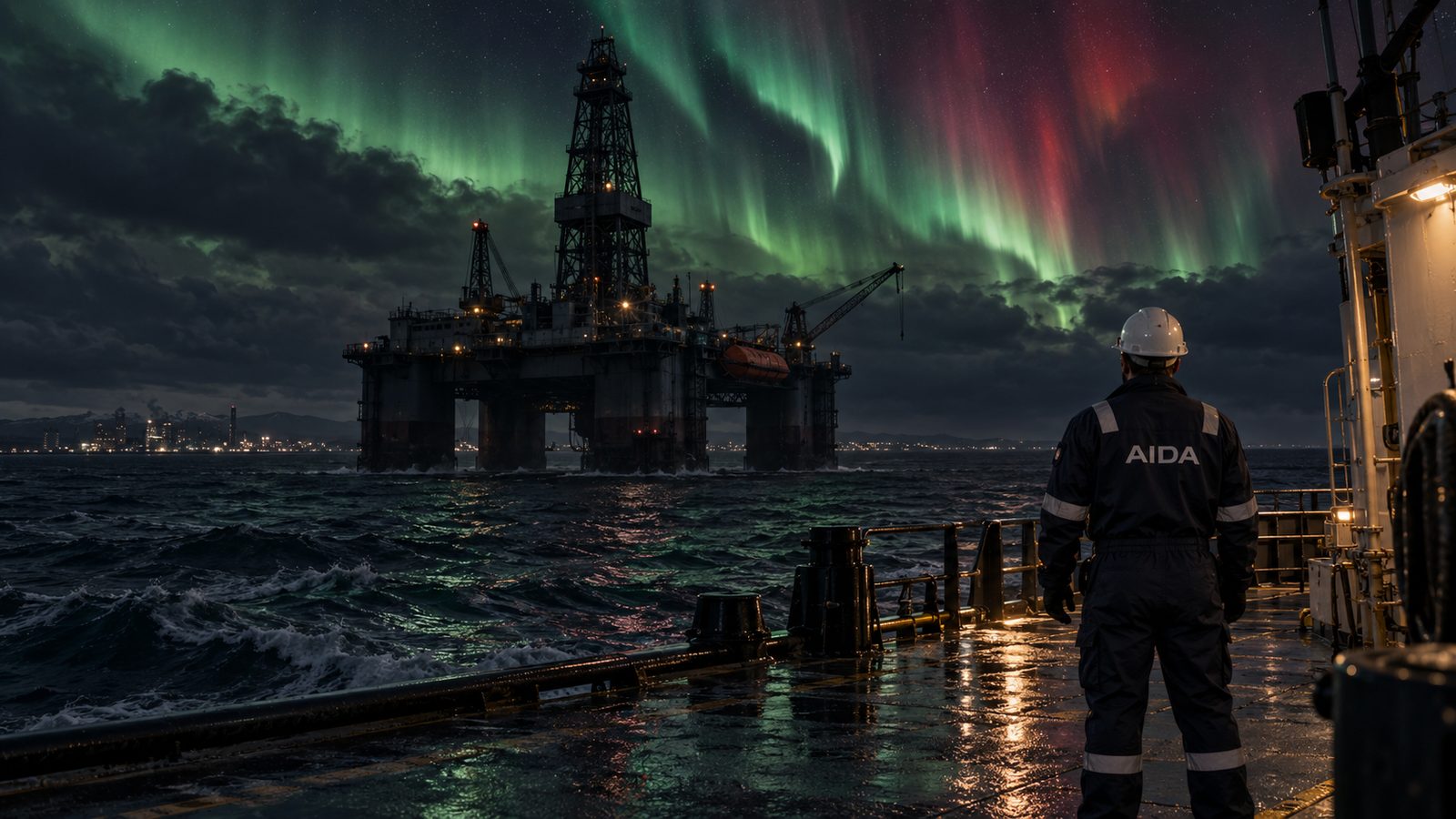
On a rig or a vessel we are used to planning for failure. We have emergency power, spare equipment, alarms, procedures and evacuation options. If something happens, there is normally an organisation onshore that can assist.
But what happens if the event also hits the people who are supposed to help us? What if communications fail, supplies stop arriving and critical infrastructure becomes unavailable across large areas? How long can we keep people safe with the resources already on board?
These are questions AIDA wants to explore through its work on electromagnetic vulnerability and technical preparedness. The starting point is to understand which functions we depend on, how they can fail at the same time, and what it takes to maintain safe operation.
EMP stands for electromagnetic pulse, a short-lived electromagnetic disturbance that can induce voltages and currents in electrical systems. Depending on the disturbance and how well the equipment is protected, the result can be anything from a temporary upset to permanent damage.
A nuclear explosion high in the atmosphere can create an EMP over a large area. This applies to thermonuclear weapons, often called hydrogen bombs, but the phenomenon is not limited to that type of weapon. Such an event can have fast components that affect electronics, and a slower component that can affect long electrical conductors. Both individual equipment and interconnected systems therefore have to be assessed. (Source: US Department of Energy.)
A solar storm works through different mechanisms. The Sun can emit radiation, energetic particles and large eruptions of plasma carrying magnetic fields. Given the right conditions, this can disturb satellites, radio communication, navigation and the Earth's magnetic field. When the magnetic field changes, electric currents can arise in long conducting systems on the ground. Power grids and their transformers are among the systems that can be affected. (Source: NOAA.) Solar storms, nuclear EMP and other cosmic radiation events therefore have to be assessed separately. The protection has to match the actual threat.
The Earth has been hit before. In September 1859 a violent geomagnetic storm struck. The Carrington Event is named after the astronomer Richard Carrington, who observed an intense solar flare shortly before the storm. Aurorae were seen far outside their usual latitudes. Telegraph systems suffered severe electrical disturbances, and sparks and fires were reported at telegraph stations. The long communication lines of the day made the effect visible. (Source: NASA, historical observations from 1859.) Today our dependence on electrical infrastructure is far greater, which is why the event remains relevant when we assess society's technical vulnerability.
On 13 March 1989 a geomagnetic storm contributed to the collapse of Hydro-Québec's power grid. In around 90 seconds, roughly six million people lost power. The outage lasted about nine hours. The event showed that space weather could become a serious problem for modern power supply. (Source: NOAA.)
In July 2012 NASA's STEREO-A spacecraft recorded an exceptionally powerful solar eruption. It did not hit the Earth. The measurements nonetheless showed that, under unfavourable conditions, it could have produced a geomagnetic storm on the scale of the Carrington Event. It was a reminder that the Sun still produces such eruptions. Direction and magnetic conditions are decisive for the consequences. (Source: NASA.)
The largest events may lie in nature's own archives. Modern instruments cover only a tiny part of the Earth's history. To investigate older events, researchers use tree rings and ice cores, among other things. Energetic particles can increase the formation of particular isotopes in the atmosphere. Carbon-14 can be preserved in trees, while beryllium-10 and chlorine-36 can be found in ice. Together such traces provide information about extreme particle events.
Clear traces exist from the years 774–775 and 993–994 AD. Research combining several isotopes points to extreme solar particle events as the explanation. Such abrupt spikes are commonly called Miyake events. (Source: Mekhaldi et al., Nature Communications.) An even older trace has been dated to around 12,350 BC, roughly 14,300 years ago. A study published in 2025 supports the view that it was caused by the most powerful solar particle event identified so far. The researchers estimate it at roughly 18 per cent larger than the event of 775. (Source: University of Oulu.)
This tells us that the Sun has produced extreme particle events. The isotope traces do not, however, give a direct measurement of the load a modern power grid would have been exposed to. We cannot therefore use the size ratio as a multiplier for the damage from the Carrington Event.
The disturbance can also come from deep space. On 9 October 2022 radiation from the gamma-ray burst GRB 221009A reached the Earth. The source was around two billion light years away. Even so, the event produced measurable disturbances in the ionosphere, including a sharp change in the electric field high in the atmosphere. ESA also describes how a sufficiently close and unfavourably directed gamma-ray burst could hypothetically damage the ozone layer. That would be a different kind of hazard from an electrical pulse through the power grid. (Source: ESA.)
Another widely reported event was the Amaterasu particle, recorded in 2021 and presented in 2023. It carried extreme energy and appeared to come from a direction with no obvious source, which is why it was described as coming from "nowhere". It was a cosmic particle, not an EMP that knocked out infrastructure. (Source: University of Utah.) Such events show how much we are still learning about the most energetic processes in the universe. They also show why precise terminology matters when we move from fascinating observations to technical risk assessments.
A power grid normally gains reliability through interconnection. Regions can support one another and power can find alternative routes. Under severe disturbances, faults can nevertheless develop into chain reactions. The blackout in the United States and Canada in August 2003 affected around 50 million people. It was not caused by a solar storm, but it demonstrated how far-reaching the consequences of failure in an interconnected power system can be. (Source: US Department of Energy.)
The United States has three main systems across the contiguous 48 states: Eastern, Western and ERCOT, which covers most of Texas. The country is therefore not a single synchronous grid. (Source: EIA.) An extreme space weather event can still affect several regions at once. The US authorities describe the risk of widespread power outages and consequences for other sectors that depend on electricity. (Source: GAO.)
For AIDA this is a central point: a serious societal crisis does not require all electronics to be destroyed. It may be enough that essential services fail at the same time and remain unavailable for a long period.
What follows is AIDA's dramatised disaster scenario: four weeks without the society we know. We assume extensive damage to the power supply in several regions, disrupted communications and prolonged problems with supplies and repairs. This is not a scientific forecast for any particular solar storm. The timeline is a storytelling device, not a set of calculated thresholds.
The first day, we wait for someone to fix it. The power goes. The lift stops. The ventilation falls silent. People open the fuse box, look out of the window and discover that the neighbouring buildings are dark too. Most expect it to pass. Phones work in some places, but the connection deteriorates. Payment terminals fail. Trains stand still. Information is contradictory. Many cars can still drive, but fuel pumps and charging points are unavailable. A working vehicle becomes gradually less useful when it cannot be filled or charged. In high-rise buildings water pressure begins to fall where the pumps have stopped. Drains can still run by gravity, but further out in the system pumping stations stand idle. In hospitals and care homes, backup power starts where it works. For now there are reserves. For now everyone expects help.
From day two to day seven, what exists becomes what we have. Supplies do not return as expected. Chilled and frozen goods are lost where temperatures cannot be maintained. Shops have no overview of new deliveries. Drinking water, medicines, hygiene products and long-life food take on an entirely different significance. In some places neighbours organise food sharing and help. Elsewhere there is hoarding, break-ins and looting. When information stops, rumours become harder to separate from reality. Where water and sanitation fail, toilets become a growing problem. Waste piles up. Unsafe handling of sewage makes conditions worse. Those who need daily care or treatment feel the crisis early. Family may be able to help for a while. But their resources are limited too.
In weeks two and three, shortage dictates daily life. Large areas still lack stable power and regular deliveries. People spend more and more of their time obtaining water, food, heat and information. Those with medicines or fuel have to judge how much they can share and how long their stock will last. In the hardest-hit areas, scarcity and weakened government capacity can lead to robbery, violence and, in the extreme, killings. That is a possible development in the scenario. Other communities may hold together through organisation and joint effort. Fishing, hunting and growing food can help some. But large urban populations cannot quickly replace their food supply that way. It takes knowledge, resources and time. Boats and vehicles that work become important for transport and help. In areas marked by insecurity they may also become targets for theft.
Week four: who looks after those who need it most? Normal operation is still a long way off. Care homes may have to be evacuated if water, staff, medicines and backup power cannot be secured. But evacuation requires transport and somewhere able to receive the residents. Farms may have food and animals, but farmers may lack fuel, feed deliveries, refrigeration and working equipment. Production cannot simply be increased. Livestock and seed used up now can also weaken the next season's production. Some areas see conflict over supplies. Others manage to organise rationing and distribution. Who copes also depends on health, knowledge, cooperation and access to a functioning community.
Offshore, when help from shore does not come, the scenario takes a different form. On an installation, both main power and essential backup functions have failed. Communication is limited. The supply vessel does not arrive. Helicopter transport is unavailable. The crew has a finite stock of food, drinking water and medicines. The ability to produce more fresh water is gone. We do not assume that all lifeboats are destroyed. But even a working lifeboat does not necessarily resolve the situation if no one can coordinate a rescue or receive the people on board. Leaving the installation may bring new dangers. The sea is full of life. Yet the crew may lack the equipment and skills needed to catch enough food. The hardest message is perhaps not that help is delayed. It is that no one can say when it will come.
Preparedness begins with dependencies. The scenario rests on severe assumptions. Its value lies in the questions it forces. How long can the installation keep people safe without supplies? Which safety functions need power, cooling, instrument air or networks? Which backups share the same vulnerabilities as the main system? Two generators may depend on shared auxiliary systems. Several navigation receivers may depend on the same satellite signals. A backup panel may be connected to the same exposed infrastructure as the panel it is meant to replace.
For AIDA, the assessment should therefore start with the whole function: what has to work for us to produce emergency power, communicate, maintain fire safety or carry out a controlled shutdown? Then we need to examine how independent the backups actually are.
Through our own small-scale experiments we have seen electronics damaged by electromagnetic disturbance. That has made the vulnerability concrete for us. The experiments do not provide a basis for calculating the effect of a solar storm or a nuclear EMP on a whole installation. They are a motivation for further, documented work. AIDA wants to develop an approach in which critical functions are prioritised, protection is matched to the threat, and the ability to restore operation is built in from the start. The work is a direction of development. We are not presenting a finished, universally tested protection solution.
Shielding has to work as a system. For the relevant electromagnetic threats, shielded enclosures and rooms can form part of the protection. But metal walls alone are no guarantee. Doors, joints, cable penetrations, antenna connections and ventilation openings have to be assessed together. Filtering, surge protection and electrical bonding have to be matched to the system and to the threat being protected against. These are among the principles set out in CISA's guidance on EMP protection. (Source: CISA.) AIDA wants to examine how such principles can be applied to selected switchboards, control systems, communication equipment and critical spare parts in maritime environments.
HVAC has to be part of it from the start. A protected cabinet or room still needs the right operating conditions. Electronics have to shed heat, and humidity has to be managed. In AIDA's proposed approach, ventilation, cooling and electromagnetic protection are therefore developed together. The air paths have to serve both the required function and the planned shielding. The same applies to emergency power. We want to examine the whole chain of functions the generator needs in order to start and keep running, including cooling, ventilation, fuel supply and control.
AIDA also wants to look at protected spare equipment, documentation that is available without the internet, and backups of essential configurations. A spare part has limited value if it cannot be installed and put into service. Tools, competence and start-up procedures therefore have to be part of the assessment. Manual operation has to be examined concretely. A switch labelled "manual" may still depend on power and electronics further out in the system. What matters is which functions can actually be maintained when the ordinary systems are unavailable.
Technical protection can buy time. That time has to be usable for keeping people safe. We therefore want to link the assessment of safety-critical equipment to the need for drinking water, food, medicines, sanitation and communication. For offshore installations, the options of staying, evacuating or receiving help also have to be examined under changed assumptions. Access to the sea can form part of the assessment, but any food from the sea has to be a considered supplement. It cannot replace planned supplies.
The protection has to be documented. The next step must be controlled investigations on representative components and systems at qualified test facilities. Before testing, it has to be defined which threat is being examined, which functions must be maintained, and what counts as an acceptable result. Both function under exposure and the possibility of safe recovery afterwards have to be assessed. The results should describe what was tested, what worked and which limitations remain. Changes on vessels and rigs must at the same time preserve the installation's other safety functions and the necessary approvals.
History shows that the Earth has been exposed to powerful solar events. Nature's archives show that the short period of modern instrumentation does not tell the whole story. How severe a future event will be, we do not know. But we can examine our dependencies and improve our ability to handle a prolonged loss of critical services. AIDA wants to turn these questions into concrete engineering: protect essential functions, make backups more independent, and enable safe operation and recovery.
When help does not come as planned, it is the preparedness already on board that we have to be able to rely on.