Why we are building the Skyline to the extreme
We are not going to extremes for the sake of power. Technology meant to detect small changes and anticipate faults has to be tested under conditions that genuinely challenge the hardware, the software and the build.
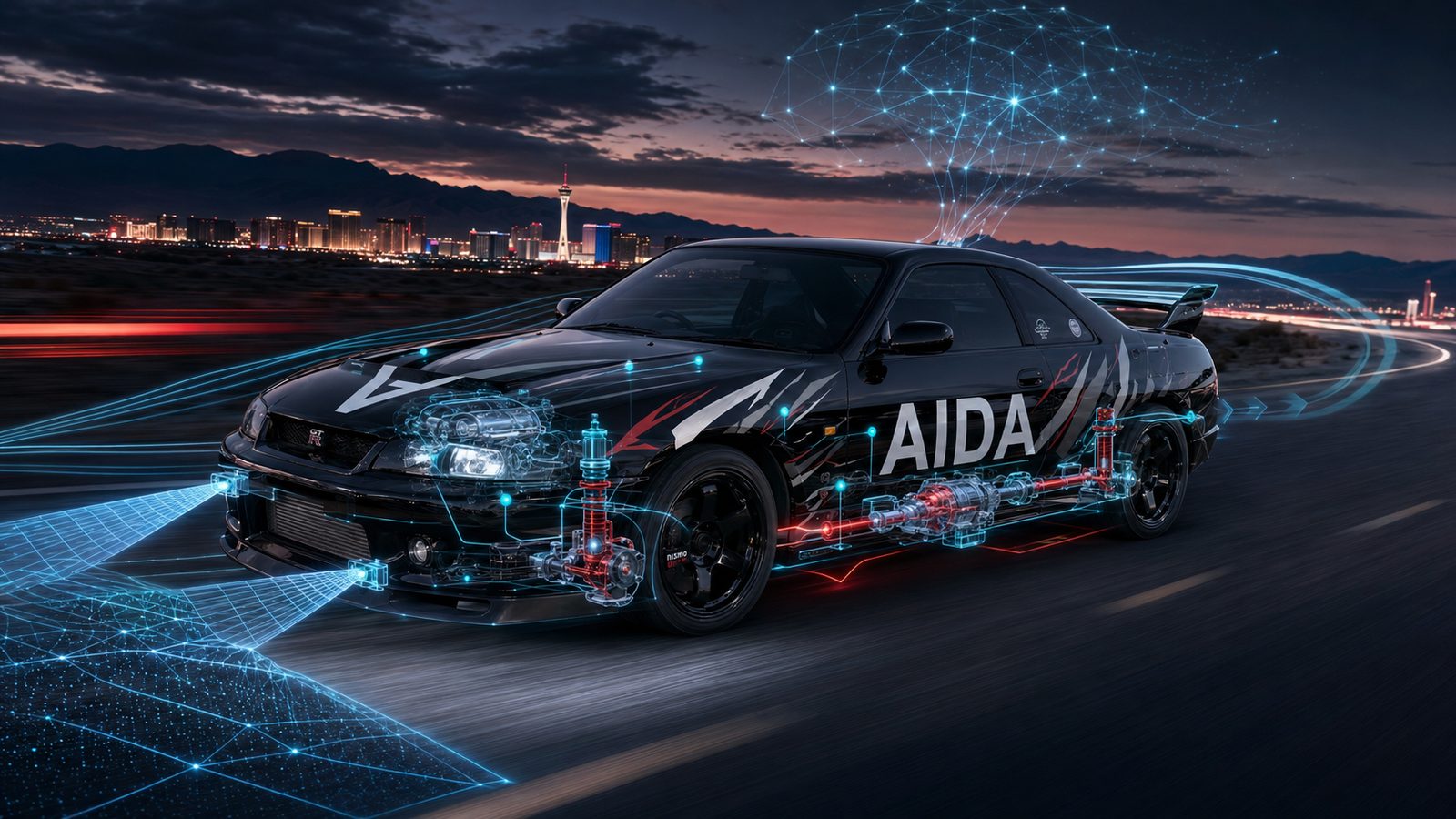
AIDA's Nissan Skyline R33 GT-R is already far from an ordinary car. But the current setup is only the starting point. The long-term plan is to develop it into an advanced technology demonstrator for PUSH, artificial intelligence, adaptive engine management, active vehicle control and predictive maintenance.
The project car is a 1995 Nissan Skyline R33 GT-R. The engine has been rebuilt from RB26 to a 2.8-litre RB28DETT stroker with forged components, balanced rotating assembly, Tomei turbos, 1500 cc Bosch Motorsport injectors, Nuke fuel rail and surge tank, twin Walbro pumps, improved cooling and flex-fuel. In full E85 and Track configuration, quoted output is 1008 hp. It currently runs a motorsport ECU supplied by Flemming Racing/FMJ, combined with Race Technology data logging and ECUMaster integration.
At the same time, the car is largely analogue compared with a modern sports car. It has no extensive factory sensor network continuously monitoring each mechanical component. That is precisely what makes it interesting: if PUSH can be retrofitted to a powerful, mechanical, analogue platform and still give detailed information about engine, gearbox, driveline and chassis, the same underlying technology can be adapted to a wide range of vehicles and industrial machines.
Before we move on to the gearbox, active suspension and aerodynamics, the car will be established with a clear legal and technical baseline. That means documenting the engine rebuild and verifying catalytic converter, emissions, lambda, noise level, SRS and the other components required for Norwegian approval. The car will be developed with two clearly defined operating configurations: Road Mode, a locked and limited calibration for public roads, and Track Mode, a separate configuration for testing on closed circuits.
An important goal is to connect PUSH with the car's ECU and other control systems. That does not mean giving a cloud-based AI uncontrolled access to engine, steering or hydraulics. The systems have clearly divided roles: the ECU handles real-time control and protection of critical engine functions; Race Technology and ECUMaster handle data logging and signal integration; PUSH captures vibration, temperature, micro-sound, running hours and load; AI analysis learns normal patterns and detects deviation; a vehicle controller provides safe real-time control of the future DCT, ATTESA, hydraulics and active aerodynamics; and the cloud platform handles long-term analysis and learning across trips.
A Linux-based computer or cloud AI must never sit directly between a critical sensor and an actuator. Commands to engine, gearbox, four-wheel drive or hydraulics have to be handled by a dedicated real-time controller with defined limits. That lets us use AI without handing safety-critical functions to a system that might respond unpredictably.
Traditional engine management is based on maps developed on a dyno and then adjusted for different loads, engine speeds, fuels and temperatures. PUSH can add a further layer: the system can compare ECU data against vibration, temperature, micro-sound, load and historical patterns. The goal is for the AI to identify which settings give the best combination of performance, stability and mechanical load under the conditions the car actually meets — but within a predefined, validated calibration envelope. The ECU keeps the final word. That is the difference between an AI that controls the engine and an AI that helps the ECU make better decisions.
The next major development phase is the gearbox. The plan is to investigate a BMW/Getrag dual-clutch transmission integrated with the Skyline's transfer case and ATTESA four-wheel drive, combining fast, precise shifts with the distinctive four-wheel drive that makes the R33 GT-R what it is. This is not a simple swap: engine management, DCT, four-wheel drive, sensors and safety functions have to work as one system.
The long-term vision goes beyond warning about faults. We want to explore whether PUSH and AI can anticipate what the car needs before the situation arises — what we call predictive vehicle dynamics. The car will gather data on vibration, temperature and micro-sound; load and running hours; suspension travel and ride height; hydraulic pressure and actuator position; g-forces, wheel load and tyre temperature; speed, steering angle and available grip; plus engine data, gear selection and torque distribution. A vibration signal on its own can be hard to interpret. Combined with temperature, load, engine speed, gear and previous measurements, it can mean something quite different.
One of the most ambitious steps is active suspension. The concept is built on mechanical springs as the fundamental, fail-safe load-bearing structure, combined with short double-acting hydraulic actuators and fast servo valves. The aim is not merely to raise or lower the car, but to control how available grip is distributed. The mechanical springs remain as a safeguard: if hydraulics, sensors or the AI function drop out, the car is still carried mechanically.
A later phase is to combine PUSH with cameras, possibly lidar, and the car's other sensors. The camera would identify corners, elevation changes, bumps and changes in required ground clearance. At that point we move from a system that reacts after the car hits an irregularity to one that tries to anticipate it.
An ordinary car in gentle use produces a fairly limited dataset. Loads are moderate, temperatures stable and changes small. A Skyline with four-wheel drive, DCT, active suspension, active aerodynamics and AI-assisted control creates a far broader basis — and that is why we are building it this way.