The liquid we could not explain
A reactor experiment developed for Karbonium left roughly one litre of clear liquid in the condenser tank. It did not behave like water — and we never had it analysed.
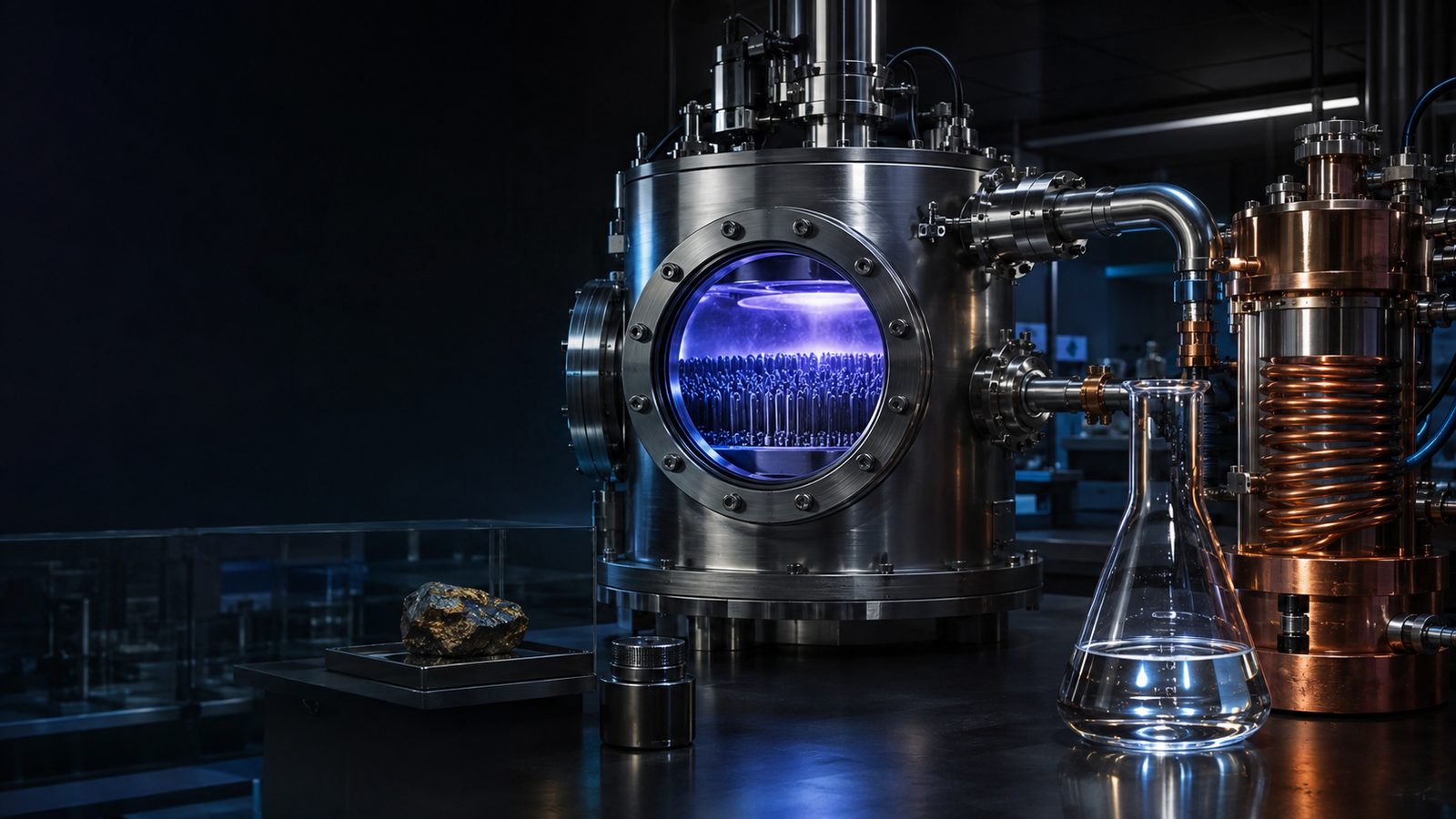
At AIDA, development rarely starts with the question of what already exists. We tend to start with a different one: what might be possible if we combine materials, gases and technology in a new way?
Karbonium is AIDA's development platform for advanced carbon structures produced in our own PECVD reactor. Using plasma, temperature, pressure and controlled gas mixtures, we can build and modify carbon structures down to the micro and nano scale.
In one earlier experiment we used a 10-micrometre pillar structure from Carbon Technology Inc. The intention was to use its three-dimensional geometry as a starting point for further growth and modification of the carbon material. The experiment showed that the process direction worked, but unwanted outgassing occurred from the carrier material. The outgassing could contaminate the process and made the approach unsuitable for the material quality we were after. It was therefore not a failed experiment: we confirmed that the principle worked, while identifying a limitation that must be removed in the next generation of the process.
The most interesting lead, however, came from an earlier, related reactor run using thorium, CO₂ and ethanol, methane and hydrogen flowing over an SS316 substrate. The original aim was to develop a new carbon material. After the process, we nonetheless found roughly one litre of clear liquid in the condenser tank. The tank consists of a copper tube 200 millimetres in diameter with water-cooled coils. Exhaust gases from the reactor pass through it, so vapour and heavier compounds can cool and condense.
When we came to empty the tank, we first assumed the liquid was ordinary water. But it behaved differently. It moved very easily in the flask and could almost appear to dance across the surface. We did not know what we had produced.
Because thorium had been used, the sample could not be sent by ordinary transport until any radioactive contamination had been ruled out. The liquid was therefore never analysed with the methods required to establish its chemical composition.
A limited, early engine test was nevertheless carried out. The condensate was mixed at roughly 75 per cent liquid to 25 per cent 98-octane petrol. The engine started and ran on the mixture. This does not prove that the condensate was in itself a finished or usable fuel. With 25 per cent petrol in the mix, neither can we conclude that the whole unknown liquid was combustible. The test did show that the mixture could be used in this limited trial without the engine stopping immediately.
There is a known chemical route from alcohol to liquid hydrocarbons. In so-called alcohol-to-jet processes, alcohol is first converted to smaller olefins, which are then coupled into longer hydrocarbon chains and hydrogenated into components usable in fuel. The reaction path typically involves dehydration, oligomerisation and hydrogenation, and has been described by, among others, the National Renewable Energy Laboratory.
That does not mean this was precisely the process that took place in AIDA's reactor. It does show that our observation may have a chemically plausible explanation. What we still do not know is whether CO₂ was incorporated into the molecules produced, what role the carbon structure played, or whether thorium influenced the reaction. Without chemical analysis, these remain hypotheses.
AIDA now wants to reopen this line of research. The new experiment will be structured so that each individual factor can be isolated, and the process must be compared against reference runs without thorium, without CO₂ and with alternative carbon structures. Condensate and gas products must be collected in a closed system and analysed by a laboratory able to handle both chemical samples and any radioactive contamination. Only through analyses such as GC-MS, FTIR, elemental analysis and radiological control can we establish what the liquid actually consists of.
We are not claiming that AIDA has already developed a finished, CO₂-based fuel. That would require documentation we do not yet have. But we have observed that a process developed for Karbonium left behind an unexpected liquid, we have seen that the liquid could form part of a fuel mixture, and we know chemical routes that could explain part of the result.
Karbonium began as a project to develop a new future material. The same technology may now also have opened the door to a new fuel track — one where CO₂ is not only treated as an emission, but examined as a possible feedstock.
These are exactly the kinds of results AIDA is built to follow up.